



The Wellness Workout Everyone's Talking About
Infrared light, sometimes referred to as ‘red light’, is a long-wavelength light that can penetrate deep into the skin. It’s something we’re starting to hear a lot about as the term ‘red light therapy’ gains traction.
Red light refers to the longest wavelengths of light in the visible spectrum that are perceptible to the human eye. As these wavelengths become longer, light gradually becomes invisible. While shorter wavelengths target the skin’s surface, these non-visible, longer wavelengths penetrate deeper into the body, reaching tissue and accelerating muscle recovery.
But what does that mean in practice? And more importantly, can infrared light be used to optimise our health? Research by Glen Jeffery, Professor of Neuroscience at the UCL Institute of Ophthalmology, points to the benefits of longer-wavelength light in supporting mitochondrial function and increasing ATP production, effectively enhancing the body’s energy output and physiological performance.
As a lighting designer who has used infrared light as a medium in my own projects, I was aware it exists beyond the visible spectrum, a long-wavelength light we cannot perceive with the naked eye. This is precisely what made me curious about joining an Infrared Hot Pilates class. Rather than a visual experience, I expected something more internal: an observation of how the body feels and responds.
Within the first few minutes, I realised the room didn’t feel ‘heated’ in the way a typical hot yoga studio does, where warmth builds heavily through the air. There was no dense, enclosed heat from conventional systems. The air remained breathable, almost neutral. And yet, my muscles began to loosen unusually quickly, like I had already completed a warm-up I hadn’t consciously experienced.
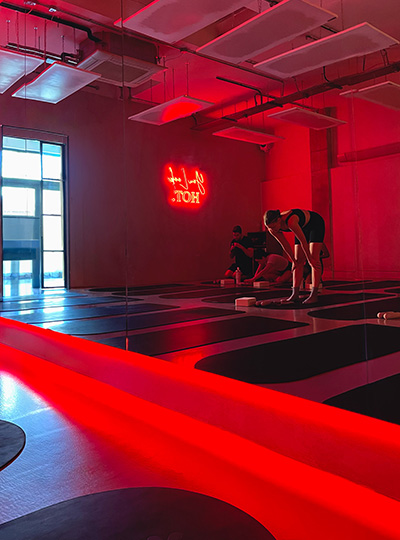
The sensation was closer to being under sunlight. The longer I stayed, the warmer I felt. It became increasingly clear that the heat was not surrounding me but reaching me.
This comes down to how infrared behaves: it heats the body directly rather than the surrounding air. The body itself becomes the point of absorption. With roughly 60% water content, it readily absorbs long wavelength light, creating a sense of heat that builds internally rather than filling the space.
As someone trained to think about illumination in terms of lux levels and colour temperature, this was disorienting in the best way. The ‘light’ in the room wasn’t for vision. It was for absorption.
The warmth seemed to come from within rather than around me. Movements felt more fluid earlier on. Stretching no longer required the same negotiation with stiffness. It was as if the barrier between intention and motion had been quietly lowered. As the class progressed, that ease shifted into something more challenging. There was a point where I could feel my heart rate rise, pushing closer to my limit. The heat built steadily, and suddenly I was sweating heavily, far more than I expected, almost like it had been switched on. It wasn’t overwhelming, but it was intense in a way that felt internal rather than environmental.
What surprised me most was the quality of that effort. Pilates is inherently precise and controlled, often revealing even the smallest limitations in the body. Here, that precision remained, but the resistance felt different. There was less friction, physically and mentally, even at that higher intensity. I wasn’t forcing my body into alignment; I was arriving there more naturally, even as I was being pushed further than I anticipated.
Straight after the class, I felt surprisingly fresh. What stayed with me even more was how I felt over the following days, as there was none of the usual soreness I’ve come to expect after Pilates. It made me feel like the infrared wasn’t just supporting the workout itself, but also quietly helping my body recover afterwards.
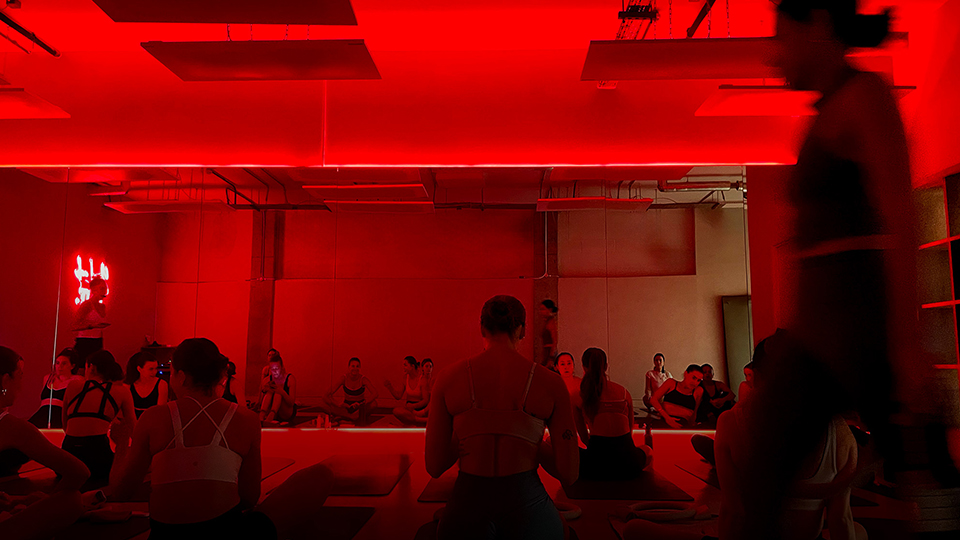
From a design perspective, what struck me most was how this reframes the role of light entirely. We often talk about light in terms of atmosphere or function – how it shapes a space visually or emotionally. Infrared introduces a third dimension: physiological interaction. Light is no longer just shaping what we see, but influencing how we feel, how we move, and how we perform.
It raises important questions. What happens when lighting design extends beyond perception into physical experience? When it actively participates in the activity taking place, rather than simply supporting it?
By the end of the session, I realised I had spent an hour engaging with something I couldn’t see but could clearly experience. Stepping back into the comparatively cool air, the absence of that subtle, enveloping warmth was just as noticeable as its presence had been.
For a lighting designer, that shift is compelling. We are used to designing for the eye. Infrared invites us to design for the body.

